
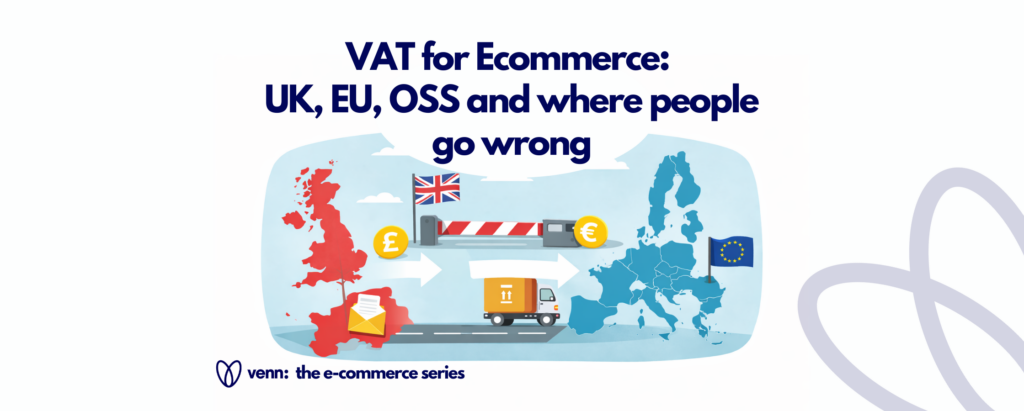
VAT for ecommerce founders can become complex very quickly.
As soon as you scale beyond hobby level, sell through platforms like Shopify or Amazon, or start shipping to Europe, the rules change. Many founders only realise there is a problem when HMRC, or a foreign tax authority, contacts them.
This guide explains:
- How VAT works for UK ecommerce businesses
- What taxable turnover actually means
- What changes when you sell to the European Union (EU)
- What OSS is and when it applies
- The most common VAT mistakes ecommerce founders make
What Is VAT?
VAT stands for Value Added Tax. It is a consumption tax charged on most goods and services in the UK.
If your business is VAT registered:
- You charge VAT on your sales
- You collect that VAT from customers
- You submit VAT returns to HM Revenue and Customs (HMRC)
- You can usually reclaim VAT on eligible business expenses
You are essentially collecting tax on behalf of the government.
For ecommerce businesses, VAT is transaction based. This means errors multiply quickly when you are processing high volumes of sales.
What Is Taxable Turnover?
One of the most misunderstood areas is taxable turnover.
In the UK, you must register for VAT if your taxable turnover exceeds £90,000 in a rolling 12 month period.
What does “taxable turnover” actually mean?
Taxable turnover is the total value of everything you sell that is subject to VAT. It is your gross sales value before deductions.
Taxable turnover includes:
- Standard rated sales, currently 20 percent
- Reduced rate sales, currently 5 percent
- Zero rated sales, such as certain children’s clothing
Zero rated sales still count towards the VAT threshold, even though VAT is charged at 0 percent.
For ecommerce founders, the key point is this: you must monitor rolling 12 month sales, not just your financial year. You can cross the threshold mid-year and be required to register within 30 days.
UK VAT for Ecommerce Businesses
Once VAT registered in the UK:
- You usually charge 20 percent VAT on most goods
- You submit VAT returns, typically quarterly but you can opt to do so monthly.
- You must comply with Making Tax Digital (MTD) rules, meaning digital record keeping and compatible software.
If you use platforms such as Shopify, Amazon or Etsy, your accounting system must reconcile to gross sales data, not just net payouts.
A common issue is recording the amount received in the bank after fees, refunds and charges. VAT is calculated on the full selling price charged to the customer, not what the platform pays you.
Selling to the EU After Brexit
Since Brexit, the UK is treated as a non-EU country for VAT purposes.
This has significant implications for ecommerce founders selling physical goods to EU customers.
There are two main scenarios.
Shipping From the UK to EU Customers
If you ship goods from the UK directly to customers in the EU:
- The sale is treated as an export from the UK
- UK VAT is usually not charged
- Import VAT is due in the customer’s country
Holding Stock in the EU
If you store stock in an EU country, for example through Fulfilment by Amazon (FBA), the VAT position changes again.
What Is OSS?
OSS stands for One Stop Shop.
It is an EU VAT scheme designed to simplify reporting for businesses making cross-border sales to consumers within the EU.
Under OSS:
- You register in one EU member state
- You file a single quarterly OSS return
- You declare and pay VAT due across multiple EU countries
However, there are important limitations.
UK businesses cannot access the standard Union OSS scheme unless they have an establishment in the EU. Instead, they may use Non Union OSS or register for VAT in a specific EU country.
OSS does not remove the need for local VAT registration where stock is stored. If your inventory sits in Germany, you will usually still need a German VAT number.
Where Ecommerce Founders Go Wrong
Focusing Only on UK VAT
Many founders carefully monitor the UK VAT threshold but ignore EU obligations. Once you hold stock or create a taxable presence in an EU country, local VAT rules apply regardless of UK turnover.
Not Understanding Where Stock Is Located
Amazon and other fulfilment providers may move stock between warehouses in different countries.
If stock is moved to Poland or Spain, you may create a VAT registration requirement there without actively deciding to do so.
Misunderstanding Taxable Turnover
Some founders assume zero rated sales do not count towards the £90,000 threshold. They do.
Others incorrectly exclude marketplace sales because the platform “handles the VAT”. In most cases, those sales still form part of your taxable turnover calculation.
Reconciling to Bank Receipts Instead of Gross Sales
Marketplace payouts are net of:
- Platform fees
- Advertising charges
- Refunds
- Chargebacks
VAT must be calculated on the gross amount charged to the customer. If you rely solely on bank statements, your VAT returns will likely be inaccurate.
Assuming OSS Solves Everything
OSS is helpful, but it is not a universal solution.
It does not cover:
- Stock held in multiple EU countries
- All types of supplies
- Certain marketplace facilitated sales
Using OSS without understanding its limits can create gaps in compliance.
How to Stay VAT Compliant as You Scale
For UK ecommerce founders, VAT should be part of your growth planning.
Practical steps include:
- Monitoring your rolling 12 month taxable turnover
- Understanding exactly where your stock is physically located
- Reviewing your fulfilment and delivery model for EU sales
- Ensuring your accounting software captures gross sales correctly
- Seeking specialist advice for cross border VAT
Ecommerce businesses generate high volumes of transactions. Small VAT errors, repeated thousands of times, can create significant liabilities.
Summary
VAT for ecommerce founders operating in the UK and EU is more technical than many expect.
Between UK VAT registration, EU VAT numbers, IOSS, OSS and marketplace rules, the compliance landscape is layered and constantly evolving.
Getting VAT right early:
- Protects margins
- Reduces the risk of penalties
- Prevents disruptive backdated registrations
- Strengthens your position if you seek investment or plan to exit
Get it right first time, because the costs of not doing so can be catastrophic.