
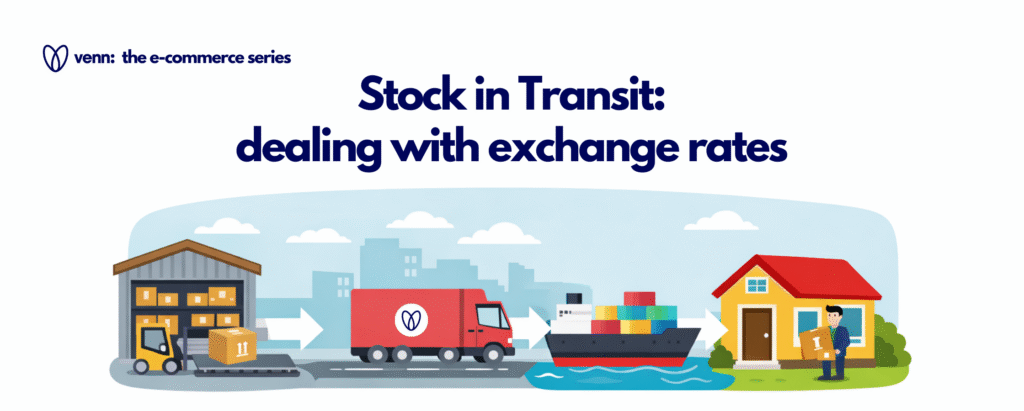
If you import goods, exchange rates can distort your stock value, cost of goods sold (commly abbreviated to COGS), and profit. This usually shows up when you pay suppliers in stages and the exchange rate moves between payments.
Let’s walk through a common ecommerce scenario and how to account for it cleanly.
The scenario
You are a UK company importing stock from China.
-
Total supplier invoice: USD 100,000
-
Payment terms:
-
30% paid before goods leave China.
-
70% paid just before the goods arrive at your UK warehouse
-
-
The exchange rate changes between the two payments
-
The goods are in transit at your month end
This is where people often ask ‘what exchange rate should I use, and what does this do to my stock value?’.
The key accounting principle
Stock should be recorded at its actual cost, in your base currency, including the real exchange rate paid.
That means there is no single correct exchange rate for the whole shipment if you paid at different times.
Each payment is translated at the exchange rate on the date you actually paid it.
How this works in practice
Step 1: Record the deposit
When you pay the 30% deposit, convert it using the exchange rate on that day.
Example:
-
Deposit: USD 30,000
-
Exchange rate on payment date: 1.25
-
GBP cost recorded: £24,000
At this point:
-
Cash goes down by £24,000
-
Stock in transit (or prepayments) goes up by £24,000
This amount is fixed. You do not revalue it later just because exchange rates move.
Step 2: Record the balance payment
When you pay the remaining 70%, use the exchange rate on that payment date.
Example:
-
Balance: USD 70,000
-
Exchange rate on payment date: 1.20
-
GBP cost recorded: £58,333
Again:
-
Cash goes down by £58,333
-
Stock in transit increases by £58,333
Step 3: Total stock cost
Your total stock value becomes the sum of both payments:
-
£24,000 + £58,333 = £82,333
That is the true landed cost of the goods before freight, duty, and other import costs.
Once the stock arrives, this balance moves from stock in transit into inventory and later flows through COGS when you sell it.
What about the exchange rate difference?
In this example, the exchange rate movement does not create a separate gain or loss on the supplier invoice itself, because you are recording the actual cost paid at each stage.
However, exchange differences can still appear in two common situations.
Option 1: Revaluing unpaid balances at month end
If you have not yet paid the 70% balance at your month end, accounting standards usually require you to revalue the outstanding USD liability using the month-end exchange rate.
That revaluation difference goes to the profit and loss account as an unrealised exchange gain or loss.
Once you actually pay the invoice, the difference between the revalued amount and the final payment rate becomes a realised exchange gain or loss.
This does not change the original deposit amount. It only affects the unpaid portion.
Option 2: Using a clearing or stock-in-transit account
Many ecommerce businesses use a stock-in-transit or goods-received-not-invoiced account.
This allows you to:
-
Accumulate deposits, balance payments, freight, duty, and insurance
-
Keep exchange differences clearly separated
-
Move the final total into inventory only when goods are received
This is especially helpful if shipments cross month ends or you import frequently.
What you should watch out for
-
Do not use a single average exchange rate for the whole shipment if payments were made at different times
-
Do not revalue deposits already paid. They are fixed at the rate on the payment date
-
Make sure freight and duty are added to stock value, not expensed immediately
-
Expect some exchange gains or losses if invoices are unpaid at period end
The takeaway
For imported stock, exchange rates are not something to smooth out or ignore. The clean approach is to record each payment at the rate you actually paid and let the accounting system reflect reality.
Done properly, this keeps your margins accurate, your stock valuation clean, and your profit figures trustworthy.