
If you run a business in the UK, understanding VAT invoicing rules is critical for businesses so VAT can be reclaimed correctly and accurately reported. In this guide, we explain what a tax invoice is, what HMRC requires, and how to ensure your invoicing processes are still VAT compliant. It is equally important to provide your bookkeeper with a VAT compliant invoice for business purchases to ensure that you are ready for any future tax inspections.
What Is a Tax Invoice?
A tax invoice is an official document issued by a VAT-registered business showing that VAT has been charged on the goods or services supplied. HMRC uses tax invoices as the primary evidence for VAT reporting and VAT recovery.
For your VAT purposes, a valid tax invoice allows you to reclaim input VAT (if eligible) on your purchases. Issuing a tax invoice on your sales keeps you compliant.
When Is a VAT Tax Invoice Required?
If you are VAT registered, you must issue and receive a VAT tax invoice when supplying or buying taxable goods or services with another VAT-registered business. This is most common in business-to-business transactions.
For lower-value sales (under £250 including VAT), HMRC allows the use of simplified tax invoices, which are commonly used in online retail and POS systems.
HMRC Requirements: What must a VAT Tax Invoice include?
A full VAT invoice is a document that complies with all the requirements of VAT Regulations, containing the following particulars:
- A unique sequential number: This number should be based on a series of numbers that you use to identify your invoices.
- The time of supply: This is the time when the goods or services were supplied.
- The date of issue: This is the date when the invoice was issued.
- Your company’s name, address, and VAT registration number: This information should be the same as the information on your VAT registration certificate.
- The name and address of the customer: This is the person who is buying the goods or services.
- A description of the goods or services: This description should be clear and specific enough to identify the goods or services being supplied.
- The quantity of the goods or the extent of the services: This information should be included for each item on the invoice. Some items may be exempt from VAT and therefore should be itemised.
- The rate of VAT and the amount payable, excluding VAT: This information should be included for each item on the invoice.
- The total amount payable, excluding VAT: This is the total amount of the invoice, before VAT is added.
- The rate of any cash discount offered: If you are offering a cash discount, you must state the rate of the discount.
- The total amount of VAT chargeable: This is the total amount of VAT that is due on the invoice, expressed in sterling.
- The unit price: This is the price of each individual item on the invoice.
- Margin Scheme: If you are using a margin scheme, you must include a relevant reference or indication on the invoice.
- Reverse Charge: If the invoice relates to a supply where the customer is liable to pay the tax, you must include a relevant reference or indication on the invoice.
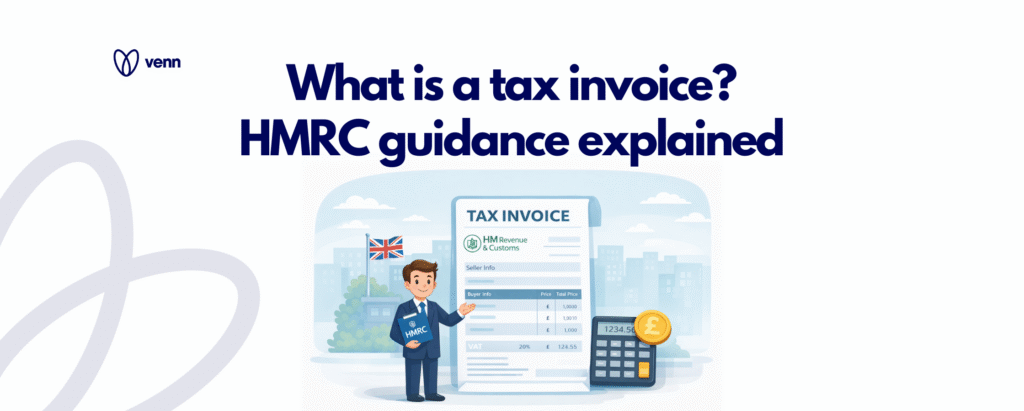
To see this in action, look at the illustrated example below.

Simplified VAT Tax Invoices Explained
Simplified VAT invoices can be used for sales of £250 or less (including VAT). These invoices must still show VAT has been charged but can omit some customer details.
A simplified invoice must include:
• Supplier name and VAT number
• Invoice date
• Description of goods or services
• Total amount including VAT
• VAT rate applied.
This includes receipts for small purchases like taxi travel, food and drink, office sundries etc.
Digital Invoicing for Tech & E-commerce Businesses
HMRC allows VAT invoices to be issued and stored digitally, provided they are correct, legible, and securely stored. Automated document systems like Dext, Hubdoc and others must still follow VAT rules. When you upload your invoices and receipts to this kind of software, you need to check whether it is legible and captures all the details. The software extracts the document information and can make mistakes if the document is increased, faded or the font is too small or complicated.
Common VAT Invoice Errors That Cause HMRC Issues
- Missing or incorrect VAT registration numbers
• Incorrect VAT rates applied to digital or cross-border sales
• Treating pro-forma invoices, order copies and email summaries as VAT tax invoices
• Issuing invoices late or with incorrect tax points
How Venn Accounts can help
Here at Venn, we offer a comprehensive VAT management service.
- We handle your VAT submissions, ensuring accurate calculations and timely filings to keep your business fully compliant with HMRC.
- Whether you use standard VAT accounting, the flat rate scheme, or cash accounting, we tailor our services to fit your business needs.
- If your business needs to register for VAT, we take care of the entire process, from assessing eligibility to submitting your application.
- You also receive ongoing support to ensure your VAT compliance is maintained, with expert guidance on thresholds, schemes, and record-keeping.