
Whether or not you’re a B-Corp, you’ll have heard of carbon accounting. If (like us) you ARE a B-Corp, it’s probably on your mind, because the new B Corp standards now require companies to measure Scope 1, 2 and 3 emissions, rather than it just being an option you can score points on.
While this sounds complicated and expensive, in reality it’s becoming much more practical. There are now tools that can calculate much of it automatically from your financial data, and the process often starts much smaller than people expect.
What Is Carbon Accounting?
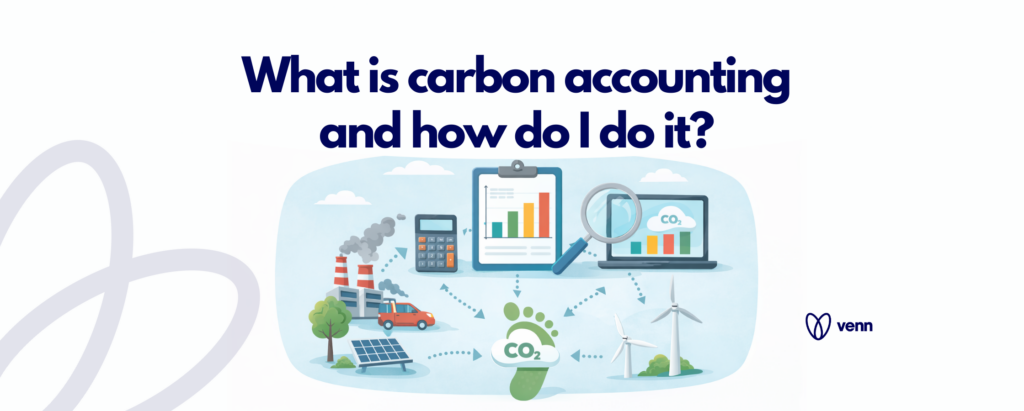
Carbon accounting is the process of measuring the greenhouse gas emissions your company creates.
Most businesses measure emissions in “tonnes of CO₂ equivalent” (usually abbreviated to CO₂e). This unit combines different greenhouse gases such as carbon dioxide, methane and nitrous oxide into a single comparable number.
The aim is not just reporting the climate impact your business activities generate; once you know where the emissions come from, you can start reducing them.
Emissions often come from a variety of places, some of which might not be immediately apparent:
- Cloud computing and data centres
- Employee commuting
- Business travel
- Purchased software and services
- Manufacturing of hardware products
- Office energy use
This is why emissions are broken down into categories called Scopes.
Understanding Scope 1, 2 and 3 Emissions
Emissions are grouped into three categories under the Greenhouse Gas Protocol, which is the global standard used by most companies, and by B Corp.
Scope 1: Direct emissions
Scope 1 emissions come directly from things your company owns or controls.
Examples include:
- Gas used to heat your office
- Fuel used in company vehicles
- On-site generators
Scope 1 also includes something called “fugitive emissions”, which covers things like leaks from your refrigeration or air conditioning units.
Many tech companies have very little Scope 1 emissions, especially if they are remote-first businesses.
Scope 2: Purchased energy
Scope 2 emissions come from electricity or energy you purchase.
Examples include:
- Electricity powering your office
- Energy used in coworking spaces
- Electricity used by company-operated facilities
Although you generally don’t generate these emissions yourself, you are responsible for them because your business consumes the energy. Note that if you’re remote, the energy you use at home doesn’t fall into this category, it sits in scope 3 below.
Scope 3: Everything else in your value chain
Scope 3 emissions are all the indirect emissions created by your business activities.
For most tech companies, this is the biggest category by far.
Common Scope 3 sources include:
- Cloud services and data hosting
- Purchased software subscriptions
- Laptop and hardware manufacturing
- Employee commuting
- Remote working energy use
- Business travel
- Marketing spend
- Contractors and outsourced services
In many tech businesses, over 90 percent of emissions sit in Scope 3.
Practical Tools for Measuring Emissions
The good news is that carbon accounting is becoming much easier because modern tools connect directly to your financial systems.
For many companies, your bookkeeping already contains most of the data needed to estimate emissions.
Here are some common approaches:
Accounting integrations (Xero, QuickBooks)
Several carbon accounting platforms connect directly to accounting software and estimate emissions from your spending categories.
Examples include:
Greenly
Connects with accounting systems and banking data to estimate emissions automatically.
Normative
A more advanced platform often used by scaling companies and those preparing for certifications like B Corp.
Plan A
Used by many European startups and includes reduction planning tools.
These platforms typically:
- Pull transaction data from Xero or bank feeds
- Categorise spend (travel, software, hardware etc.)
- Apply emissions factors to estimate carbon impact
This approach works particularly well for service and software businesses.
Specialist carbon consultants
Some companies prefer working with consultants, especially during their first carbon assessment.
Consultants typically:
- Map your Scope 1, 2 and 3 emissions
- Help gather missing data
- Build a baseline emissions report
- Recommend reduction strategies
This can be helpful if you are:
- Preparing for B Corp certification
- Reporting to investors
- Producing your first sustainability report
Often consultants will still use software platforms behind the scenes.
Manual tracking
Early-stage startups sometimes start with simpler methods such as:
- Spreadsheet-based calculations
- Energy bills
- Travel data
- Supplier information
This approach can work when the company is still small, but it becomes harder as the business scales, and is not recommended unless you have the specialist knowledge to back it up.
What Happens After Measurement: Carbon Reduction Plans
Measuring emissions is only the first step. The real goal is reducing them over time.
A typical carbon reduction plan includes three stages:
Establish a baseline
First you calculate your baseline emissions. This is the total emissions for a given year and becomes your reference point for improvement.
Identify the biggest emission sources
Many then discover that a small number of areas drive most emissions.
For tech companies this could be:
- Cloud infrastructure
- Business travel
- Purchased hardware
- Marketing spend
- Data storage
Once you know where emissions sit, it becomes much easier to target improvements.
Implement reduction actions
Typical reduction actions include:
Greener infrastructure
- Moving to cloud providers powered by renewable energy
- Reducing unnecessary data storage
Travel policies
- Prioritising rail over cars/flights.
- Reducing unnecessary travel
Procurement choices
- Buying refurbished hardware
- Working with lower-carbon suppliers
Office energy
- Renewable electricity tariffs
- Energy efficient offices
You can also choose to offset a portion of your emissions, although most sustainability frameworks emphasise reducing emissions first before offsetting.
Why This Matters
Carbon accounting is moving from a niche sustainability activity to something that customers and investors expect.
The good news is that for many businesses:
- The process is simpler than expected
- Much of the data already sits in your accounting software
- Modern tools automate a large part of the work
In practice, the first step is usually straightforward: calculate your baseline emissions and understand where they come from. Once you have that visibility, building a reduction plan becomes much easier.
And if you need a hand, we’re here to help.